Your Ad Here

Wednesday, May 28, 2008

Grief Turns to Fury in China

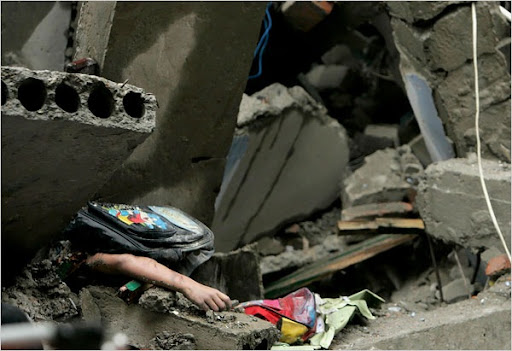
Raw public outbursts have been taking place across northern Sichuan Province as grieving parents have been loudly calling for investigations into why so many school buildings collapsed during the May 12 earthquake, killing an estimated 10,000 children. During a march on Sunday, a protester waved a picture of one of the 127 children who died at the Fuxin No. 2 Primary School in Mianzhu.


A memorial service for hundreds of students of Juyuan Middle School in Dujiangyan, where a mother held a picture of her son, turned into an angry protest on Tuesday. Some parents said local officials had known for years that the school was unsafe but refused to take action. Others recalled that two hours passed before the rescue workers showed up; even then, they stopped working at 10 p.m. on the night of the earthquake and did not resume their search until 9 a.m. the next day.


Parents set off fireworks to chase away evil spirits as wads of paper money smoldered amid the rubble of Juyuan Middle School. Delays in launching investigations into the school collapses is likely to embolden infuriated parents who are protesting across northern Sichuan Province.


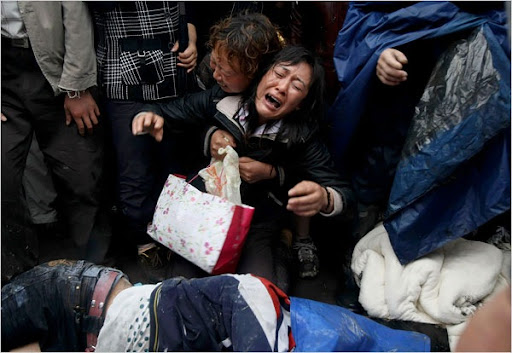
Grieving parents during the memorial service. A few parents said they had been approached by teachers and told they would be well compensated for their loss - about $4,500 per child, several times the annual income in this area - if they would stop their increasingly vociferous public campaign. But many parents rejected the offer and said they felt insulted that no one from the school or the government had come to offer condolences.

China’s Dams Under Pressure

Helicopters were used to help transport materials used to help drain the Tangjiashan mountain 'quake lake,' created by an avalanche of rocks and mud unleashed by the earthquake. At least 160,000 people had been evacuated, although hundreds of thousands of others are still living downstream in temporary camps.

River Threatens China Quake Survivors

CHENGDU, China — Faced with the prospect of massive flooding from a blocked river in the highlands of Sichuan Province, the authorities have announced plans to evacuate more than a million people should the rock-and-mud embankment give way, a threat that grew more urgent on Wednesday.

The herculean task of moving so many people, officials said, would have to be accomplished within four hours, the time it would take for the wall of water to inundate scores of cities and rural villages that are already grappling with the devastation caused by the May 12 earthquake.

Officials spent Wednesday rehearsing plans to move people from several urban areas, many of them swollen with refugees from neighboring towns and mountain hamlets. The Chinese media described evacuation drills on Wednesday that involved shuttling a few thousand people to higher ground, although it was unclear how the authorities would move so many people if the dam suddenly gave way. In Jiangyou, a city of 300,000 people, everyone would have to be moved to safety within 70 minutes, according to The Morning News.

“The efforts are aimed at getting all the 1.3 million residents on the move within four hours in case the quake lake bank fully opens, with zero deaths in the process of evacuation,” said the head of quake relief operations in the city of Mianyang, which has a population of 600,000. “Otherwise, it will mean a breach of duty on our part as government employees.”

Officials on Wednesday raised the quake’s death toll by 1,000, to 68,100; 21,000 people are still listed as missing.

Engineers and soldiers spent a second frantic day trying to alleviate pressure on the barrier lake at Tangjiashan, a swelling body of water that has been rising behind an avalanche that clogged the Jian River, two miles upstream from the city of Beichuan. Because the dam is inaccessible by road, the army has been using helicopters to fly in 30 excavators and bulldozers.

Officials said that 600 workers have been toiling around the clock to dig a sluice that would drain away some of the water, a task that could take at least five days, Yang Hailiang, an official in charge of the operation told the official news agency Xinhua. With rain in the forecast, emergency officials have been ramping up evacuation plans.

In recent days at least 160,000 people have been moved from low-lying areas, and the prospect of moving hundreds of thousands of others is likely to further strain a government struggling to provide food, water and shelter to the 15 million whose homes were destroyed.

In Tongkou, the closest settlement to the dam, villagers set up a system of gongs and fireworks to warn one another of a deluge. During a practice run in Jiangyou, 1,000 people were moved in 50 minutes. In Mianyang, officials used loudspeakers to broadcast evacuation routes.

During an earthquake relief cabinet meeting in Beijing on Tuesday, Hui Liangyu, a vice premier, expressed urgency, saying “any negligence will cause new disasters to people who have already suffered through the quake,” Xinhua reported. During the same meeting, Prime Minister Wen Jiabao told ministers that alleviating the risk of flooding from 34 so-called quake lakes was “the most pressing task” for the government. Officials also announced that $29 million in emergency funds would be allocated to the effort.

One water resources official told Agence France-Presse that the evacuations were moving too slowly. “Sometimes local governments think that evacuation is too much trouble, and they’re betting it won’t really be necessary, because they’re not sure how big the risk might be,” he said.

Cai Qihua, a local water management official, told The China Daily that the water was quickly approaching the top of the rubble wall, rising nearly seven feet a day. He said 75 feet remained until the water reached the top of the dam, although it is not clear whether that would cause the barrier to crumble. Scientists have estimated that the lake contains more than 450 million cubic feet of water.

The threat of flooding comes as the authorities struggle with the aftermath of what officials say is China’s biggest natural disaster in 30 years.

On Wednesday, Japanese officials said they were considering a Chinese request to provide tents and blankets to refugees currently living under tarps and bridges. During a news conference in Tokyo, Nobutaka Machimura, Japan’s chief cabinet secretary, said it was unclear whether Beijing would allow the Japanese military aircraft to deliver aid. If so, it would mark the first time that the military would touch down on Chinese soil since Japan’s brutal World War II occupation.

During the cabinet meeting in Beijing on Tuesday, the ministers said the government’s relief efforts had reached a “new stage,” one that should focus on burying the dead, feeding the living and preventing an outbreak of disease through an extensive inoculation campaign. They also said work should begin on reconstruction, including the restoration of crippled industries.

The ministers, however, suggested that some badly damaged towns might never be rebuilt. They said residents would be relocated, although they provided no further details. According to Xinhua, the state council urged that “social order should be maintained in the quake zones.”

In several towns, parents continued to agitate for a speedy government investigation into why so many schools collapsed during the earthquake, killing thousands of students and teachers. In Shifang, more than 300 parents whose children died at the Jiandi Middle School protested at the gates of the local government, according to Boxun News.

In Dujiangyan, a group of 500 parents gathered at a tent temporarily housing the city’s education bureau and demanded that provincial officials investigate why the Xin Jian school collapsed, killing at least 300 children. They also asked that those responsible be punished and that bereaved parents receive compensation.

According to the father of a 9-year-old girl who died at the school, about a dozen parents were allowed to talk to officials, although they left feeling dissatisfied. “They only offered some hollow ‘official talk,’ ” said the man, who would give only his surname, Qin.

Encouraged by another group of parents who protested in Mianzhu on Sunday, Mr. Qin said, the parents would stage their own “mourning” rally on June 1, which is Children’s Day in China, a national holiday.

Sunday, May 18, 2008

China quake death toll rises to 32,477

The death toll from the strong earthquake in southwest China's Sichuan Province rose to 32,477 as of 2 p.m. Sunday, and 220,109 people were injured, according to the Information Office of the State Council.

A kid need to give up his leg

A poor little boy was buried and has to give up his pair of leg to save his life.
 

Saturday, May 17, 2008

A 5 year's old boy was rescued after 72 hours buried

Over 100 pupils are still waiting ............

Thousands flee China quake area over flood fears

Thousands of Chinese earthquake victims fled areas near the epicenter Saturday, fearful of floods from rivers blocked by landslides rattled loose in this week's powerful temblor.

Soldiers carried older people out of Beichuan town — one of the areas hit hardest by the magnitude 7.9 quake Monday — while survivors cradled babies on a road jammed with vehicles and people.

A policeman told The Associated Press that rescue officials were worried that water from a choked river would inundate the town.

"The river was jammed up by a landslide, now that may burst. That is what we are worried about," the policeman said as he hurried by, not giving his name.

"I'm very scared. I heard that the water will be crashing down here," said Liang Xiao, one of the people fleeing. "If that happens, there will be over 10 yards of water over our heads."

The official Xinhua News Agency said earlier that a lake in Beichuan county "may burst its bank at any time," but did not give details on why the water was rising. Residents left homes for higher ground, but 46 seriously injured were still at risk, the agency said.

Farther north, a mountain sheared off by the quake cut the Qingzhu River and smothered three villages in a valley near Qingchuan town. No traces remained of the villages, swallowed up by a huge mound of earth behind which the cut-off river's waters were backing up.

Xinhua said more than 2,000 people were being evacuated near Qingchuan.

Meanwhile, the confirmed death toll rose Saturday to 28,881, Cabinet spokesman Guo Weimin said.

But more than 10,600 people remained buried in Sichuan province, Xinhua reported, and the government has previously said at least 50,000 people were believed killed in the disaster.

Survivors still were being found under destroyed buildings five days after the quake. A 52-year-old man buried in the ruins for 117 hours was pulled to safety in Beichuan, Xinhua reported. Two other survivors were later found alive 120 hours after the quake elsewhere in Sichuan, the agency said.

Rescuers worked through the day — using saws, drills and their hands — to free a woman pinned under a crumpled six-story apartment building in Longhua town after 124 hours in the rubble, a day after another person was pulled alive from the same place.

Covered in mud and dust, 31-year-old Bian Gengfeng was taken away by medics who covered her eyes with a towel.

Bian's 10-year-old daughter watched the rescue.

"Uncle called me yesterday and said Mom was alive and I should come and wait here," said Luo Ting.

The man pulled from the rubble the day before prompted the rescue, telling rescuers that he had been talking with a woman trapped in the building that had been housing for chemical workers.

The vast majority of survivors are rescued in the first 24 hours after a disaster, with the chances of survival dropping each day, said Dr. Irving "Jake" Jacoby of the University of California, San Diego, who heads a medical assistance team that responded to a 1989 earthquake in California, Hurricane Katrina and other disasters.

A person trapped but uninjured could survive a week or even 10 days and in extreme circumstances two weeks or more, he said.

Rescue teams from South Korea, Singapore and Russia began work Saturday. They joined a Japanese specialist group, which was the first international rescue crew to arrive in the disaster area after China dropped its initial reluctance to accepting foreign personnel.

A U.S. Air Force cargo plane loaded with tents, lanterns and 15,000 meals left Hawaii on Saturday, the first aid flight from the United States to help in Sichuan province. Another Air Force delivery was to fly in from Alaska.

Secretary of State Condoleezza Rice expressed sympathy over the tragedy to Chinese Foreign Minister Yang Jiechi during a Saturday phone call and said Washington was ready to give further support, the Chinese Foreign Ministry said in a statement.

The United Nations announced a grant of up to $7 million from its Central Emergency Response Fund, to be used by U.N. agencies and programs.

Aftershocks continued, also shaking President Hu Jintao as he praised rescue workers during a tour of the destruction.

"You carried out the order of the party, government and the central military committee determinedly. You contributed to the relief efforts," Hu told troops in Wenchuan county before the shaking prompted him to pause and glance over a hill before he went on, "despite difficulty, weariness and harshness."

The government has not given a figure for the number of people left homeless, but Housing Minister Jiang Weixin said more than 4 million apartments and homes were damaged or destroyed in Sichuan province. He said the water supply situation was "extremely serious" in Sichuan, and not flowing at all in 20 cities and counties.

Caring for the untold tens of thousands or more survivors across the earthquake zone was stretching government resources.

Just north of the provincial capital of Chengdu, the town square in Shifang had become a tent camp for 2,000 people, and coordinator Li Yuanshao reported a lack of tents. Many people walked in from surrounding towns with few belongings.

"We brought almost nothing, only the clothes we are wearing," said Zhang Xinyong, a high school junior who walked several hours to the camp.

The Ministry of Health said there had been no major outbreaks of epidemics or other public health hazards in the earthquake area, according to Xinhua. By late Friday, hospitals in Sichuan had received 116,460 patients, including nearly 16,000 severely injured.

Thursday, May 15, 2008

Quake Toll Could Rise Above 50, 000

The death toll from China's massive earthquake could soar to more than 50,000, state media reported on Thursday, as rescuers struggled to help survivors and hope faded for the thousands buried under rubble.

Some 20,000 are confirmed dead after Monday's 7.9 magnitude quake and 25,000 were buried in areas rescuers have struggled to reach, battling landslides, buckled roads and collapsed bridges.

The Communist Party told officials to "ensure social stability" as the quake spawned rumors of chemical spills, fears of dam bursts and scenes of collective desperation.23234864

Xinhua news agency said 17 "malicious rumormongers" had been punished for spreading "false information, sensational statements and sapping public confidence."

Rescuers in the city of Dujiangyan, in the worst-hit province of Sichuan, wrapped corpses dragged from the rubble in tarpaulins and sped them to morgues.

They were so busy that a notice outside one collapsed school asked parents to search for missing children in shifts.

About 130,000 army and paramilitary troops assisted the search and rescue effort in Sichuan, sifting through dozens of towns turned to rubble.

But three days after the quake, hopes of pulling survivors from the ruins dimmed and the waves of rescuers appear to be hampered by lack of specialized equipment.

Still, there were moments of joy and relief. "Thank you, thank you," one 22-year-old said after she was eventually pulled to safety, covering her face against the light in Dujiangyan. She had been trapped, unable to move, under the ruins of a hospital.

A teenage girl told Xinua how she and her classmates sang pop songs together as they lay trapped and injured in the ruins of their high school. Li Anning, 16, was trapped for 40 hours in the rubble of the five-storey school before People's Liberation Army soldiers rescued her.

FOOD AND WATER

The strains from tens of thousands of homeless were also growing.

"There is enough food but not enough water. We have only had bottled mineral water the past few days, nothing to cook with," said Wang Yujie, a teacher whose school withstood the quake.

More aid was arriving and efforts at coordination were also improving, with Sichuan setting up a hotline for victims and ambulances with Beijing licence plates on the roads.

More than 12.5 tonnes of relief goods had been airdropped and scores of helicopters were flying in rescuers and aid.

Officials said quilts, tents, food and satellite phones were needed most. The Health Ministry's Gao Qiang said medical needs ranged from basics like bandages and antibiotics to sophisticated equipment such as ventilators and kidney dialysis machines.

In some villages near the badly hit area of Beichuan, angry residents complained they had had little to eat and were forced to drink contaminated water.

Many are sleeping outside or in makeshift shelters where the lack of water and blocked toilets has raised fears of disease, but Gao said there had been no reports of epidemics.

But new threats emerged from damaged dams.

Minister for Water Resources, Chen Lei, said such damage was widespread and sounded far from assured in comments put on the ministry Web site (www.mwr.gov.cn) on Thursday.

"... Damage from the quake is extensive and the hazards are unclear," Chen said in the speech to officials.

And the minister blamed more than nature for the dangers.

"Because the management systems of hydro-power stations are not smooth and information channels are blocked, the extent of their damage is unclear," Chen said.

TRIUMPHS AMID DISASTER

Premier Wen Jiabao, a geologist himself, has made emotional appeals from the disaster zone urging on workers and comforting orphaned children.

The disaster area is also home to China's chief nuclear weapons research lab in Mianyang, as well as several secretive atomic sites, but no nuclear power stations.

The China Nuclear Engineering and Construction Corp reported that several of its facilities in Sichuan were damaged.

It did not mention any radiation leaks. A Western expert with knowledge of the Mianyang lab said it was not likely the facilities were at serious risk.

Amid the devastation, there were still small triumphs.

Rescuers reached a 62-year-old man after an all-night search, prompting a round of applause from onlookers.

A teenage girl was freed from the rubble of her school, but at the cost of both her legs which doctors had to amputate.

A 3-year-old girl was rescued after being shielded from the rubble by her dead parents.

Thirty-three tourists from Britain, the United States and France were airlifted out of a panda reserve, but Xinhua said 893 foreign tourists remained trapped. One German was among the victims, the Foreign Ministry said.

(Writing by Nick Macfie; Additional reporting by Ben Blanchard, John Ruwitch, Lindsay Beck, Guo Shipeng and Sally Huang; Editing by Jeremy Laurence)

Wednesday, May 14, 2008

Digging Through the Disaster

23202580

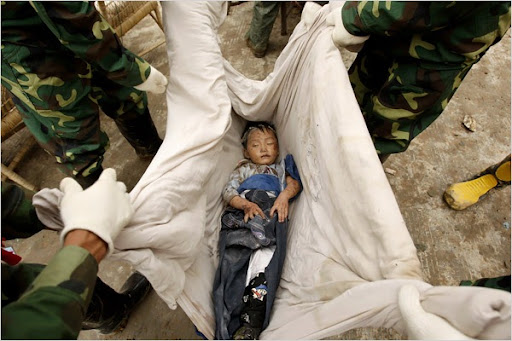
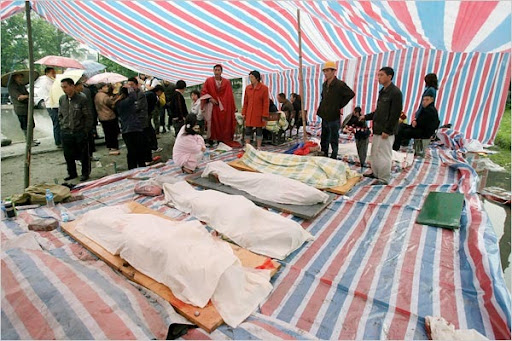
A makeshift mortuary for children killed when their school collapsed in Dujiangyan.

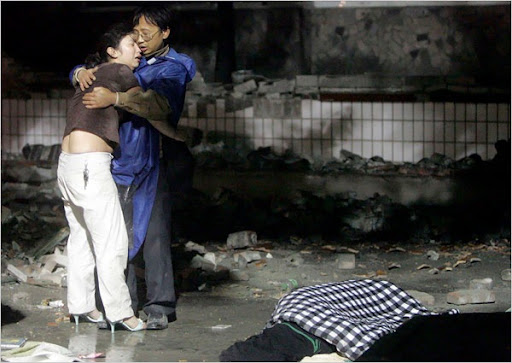
23202252 The parents of a child killed in the school collapse in Dujiangyan. The child's body is covered with cloth.

Rescue in Progress

7.8 magnitude of heavy earthquake of Sichuan Province of China, shake and beg the disaster of Wenchuan county.

Tuesday, May 13, 2008

Rescue Efforts Continue After Deadly Quake

23207032

A mother mourned near the body of her child, who was killed when a school building collapsed in Dujiangyan. At least several hundred children were killed there, perhaps as many as 900.

23204874

The official death toll has so far exceeded 12,000, making the earthquake China's deadliest natural disaster in three decades. Officials said they thought the death toll could climb dramatically higher as workers broke through to the affected areas and the full scope of the disaster became clearer.

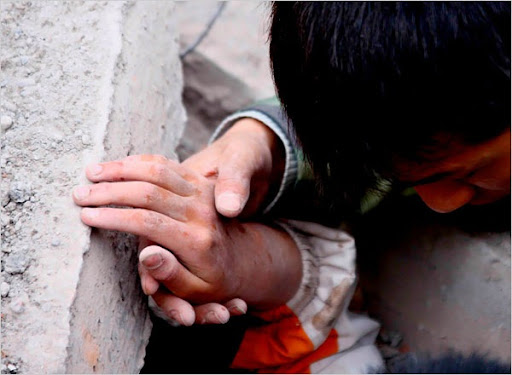
23203922 A rescuer held the hand of a trapped student at Wudu Primary School on the outskirts of Mianzhu, in Sichuan Province. Since the Tangshan earthquake in 1976, China has required that new structures withstand major quakes. But the collapse of schools, hospitals and factories in several different areas around Sichuan may raise questions about how rigorously such codes have been enforced during China's recent, epic building boom.

23204206

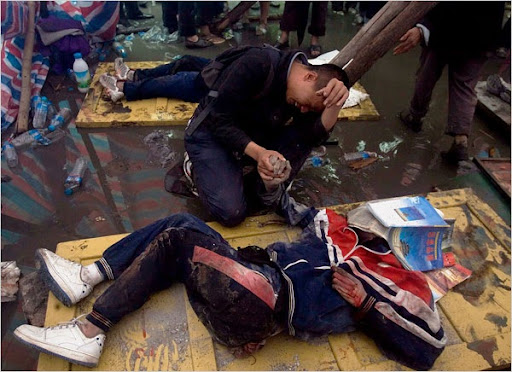
A man mourned the death of a student near the site of a school that collapsed in Juyuan. Nearly 2,000 of the dead included students and teachers killed when school buildings in the region crumbled.

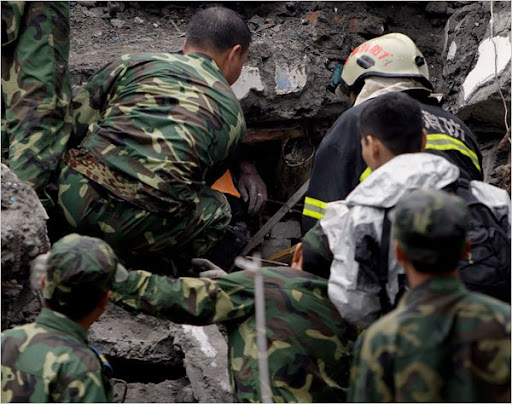
23206810 Soldiers tried to dig out a victim buried under the remains of an apartment block in Dujiangyan. The quake destroyed 80 percent of structures in some of the towns and small cities near its epicenter.

Rescue Efforts Continue After Deadly Quake

23206778An earthquake survivor at a hospital in Chengdu.

23206770

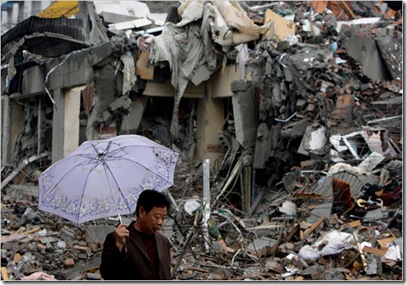
A collapsed apartment block in Dujiangyan. Tens of thousands of people across southwest China remained buried beneath rubble on Tuesday as rescue workers struggled to reach areas cut off by a powerful earthquake that has left thousands dead and hundreds of thousands of others injured or homeless. 23207864

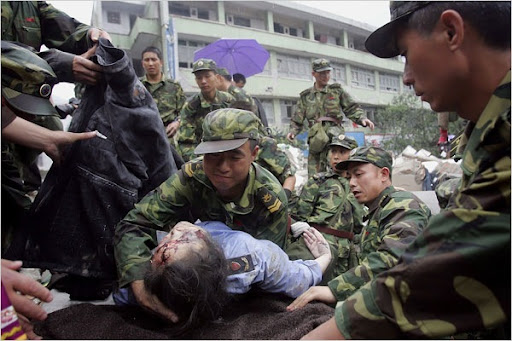
As a steady rain fell throughout the day, emergency workers struggled to pull survivors and bodies from flattened buildings in the few towns accessible to heavy rescue machinery. At left, rescuers pulled an injured woman from a collapsed building in Beichuan.

23207866

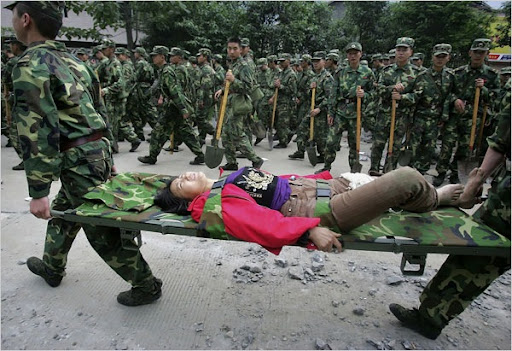
Rescue workers carried an injured woman out of the debris of collapsed buildings in Beichuan. The central government, which said it was spending $120 million on rescue efforts, has sent 50,000 soldiers to the disaster zone.

Troops Rush In to Help China Quake Rescue

Sichuan on Wednesday to quicken a search for survivors as time ran out for thousands of people buried under rubble and mud.

Across the region, weary rescuers pulled at tangled chunks of buildings and peered into crevices for survivors after Monday's 7.9 magnitude quake crumpled homes, schools and hospitals.

The government dispatched 50,000 troops to the southwestern province to dig for survivors as the national death toll climbed past 13,000. It is likely to rise steeply after state media said 19,000 were buried in Sichuan's Mianyang area alone.

On the edge of Mianyang, people roamed around a sports ground housing the homeless, holding cardboard signs with the names of their relatives in hopes of being reunited or getting information. Most were from nearby rural Beichuan county, one of the worst-hit areas.

"They have said nothing about what's going to happen to us. This is just a temporary place. I don't know when or if we'll be able to go home," said Hu Luobing, from a Beichuan village where she said everything had been destroyed.

She was leaving her daughter in the shelter of the sports ground, where some 10,000 Beichuan survivors gathered, to look for clothes.

Others were seeking food and relief from a chilly rain.

"I've had nothing to eat since last night. I've only been given some bread and a bottle of water for my child," said Bai Chenchu, one of thousands camped out at the sports ground.

Another had only the clothes on his back.

"I'm wearing everything I own," said 15-year-old Xi Dongli.

Pictures from Beichuan, a hilly area that rescuers have struggled to reach, showed near total devastation. Survivors lay alongside the dead in the open air, surrounded by buildings reduced to mangled slabs of concrete.

PREMIER'S APPEAL

Chinese Premier Wen Jiabao, who has been in Sichuan leading rescue efforts, making emotional appeals to urge on workers and visiting crying, orphaned children, was in Beichuan by midday.

"If there is a glimmer of hope, then put everything into rescuing," Xinhua quoted him as telling local officials.

Beichuan county alone was in urgent need of 50,000 tents, 200,000 blankets and 300,000 coats, as well as drinking water and medicine, Xinhua said.

"Beichuan has just disappeared. There's nothing left," said Li Changqing, a salesman in Mianyang.

The quake, the worst to hit China since 1976 when up to 300,000 died, has muffled upbeat government propaganda three months ahead of the Beijing Olympic Games.

It has also quelled criticism from abroad over recent unrest in Tibet, with images of the human tragedy and heroic rescue efforts spurring offers of aid and an outpouring of sympathy.

China's stock market initially weakened after the quake, partly on fears that it could add to inflation that is already at a 12-year high. But the market has since recovered and analysts say the economic impact is unlikely to be lasting.

The quake's epicenter, north of the provincial capital, Chengdu, has little manufacturing or rice output.

Metals plants near Chongqing, which account for about 4.5 percent of China's aluminum capacity, saw little damage. Power plants have resumed normal operations and Petrochina has restarted a major oil pipeline after a one-day stoppage.

FOOD AND SHELTER

At the Mianyang sports ground, local volunteers were distributing rice and water. One man handing out boiled eggs was mobbed, but desperate survivors were mostly orderly.

Central authorities have ordered stricken areas to ensure food supplies and price stability, but some Chinese news reports described price rises and shortages in quake-hit areas.

The extent of destruction in many towns across the mountainous area suggested searchers would find many more bodies than survivors among the toppled buildings.

Rain has frustrated rescuers' efforts to get to some areas and more rain is forecast for coming days.

"Everything became very difficult last night with the rain. There are a lot of people with no place to go," said Kate Janis, a program director with the aid organization Mercy Corps.

State media reported devastation in villages near the epicenter in Wenchuan, a remote county cut off by landslides about 100 km (60 miles) northwest of Chengdu. About 60,000 people were unaccounted for across Wenchuan, authorities said.

In Wenchuan's Yingxiu town, only 2,300 of its 10,000 residents were accounted for, Xinhua reported.

Amid the overwhelming grief, there were also moments of relief when survivors were found. In Sichuan's Mianzhu, about 500 people were pulled out alive from crushed buildings.

TVB News Report on SiChuan Earthquake May 13 (Cantonese)

ABC news: death toll reaches 12000 in China earthquake

Australia ABC TV channel news: death toll reaches 12000 in China earthquake

CNN Report on SiChuan Earthquake

May 12, 2008 CHENGDU, China -- A strong earthquake hits China and killed nearly 9,000 people in Sichuan provinces on Monday. About 900 students were trapped under the rubble of their school and caused a toxic chemical leak, state media reported. The quake hit about 60 miles northwest of Chengdu, a city of about 3.75 million in the middle of the afternoon when classrooms and office towers were full. When it hit shortly before 2:30 p.m., the quake rumbled for nearly three minutes driving people into the streets in panic. The 7.9-magnitude earthquake devastated a hilly region of small cities and towns in central China. 200 others were killed in three other provinces and the mega-city of Chongqing.
News report that 80 percent of the buildings had collapsed in Sichuan province's Beichuan county after the quake, raising fears that the overall death toll could increase sharply. State media said a chemical plant in Shifang city had cratered, burying hundreds of people and spilling more than 80 tons of toxic liquid ammonia from the site. The earthquake sent thousands of people rushing out of buildings and into the streets hundreds of miles away in Beijing and Shanghai. The temblor was felt as far away as Vietnam and Thailand. It posed a challenge to a government already grappling with discontent over high inflation and a widespread uprising among Tibetans in western China while trying to prepare for the Beijing Olympics this August. US President George W. Bush on Monday offered his condolences to China over a devastating earthquake that killed thousands of people and said the United States "stands ready to help.

China Army in Action to rescue


Update on May 13


With 11,921 confirmed deaths so far, it was the deadliest and strongest earthquake to hit China since the 1976 Tangshan earthquake, which killed approximately 250,000 people.


On May 12, 2008, China's Health Ministry said that it had sent 10 emergency medical teams to Wenchuan County in southwest China's Sichuan Province. On the same day, China's Chengdu Military Area Command dispatched 50,000 troops and armed police to help with disaster relief work in Wenchuan County but because of the roughened terrain of the land and due to its close proximity to the quake's epicentre, the soldiers found it very difficult to get help to the rural regions of the province.

The State Disaster Relief Commission initiated a "Level II emergency contingency plan" that covers the most serious class of natural disasters, which rose to Level I at 22:15 May 12 CST.

An earthquake emergency relief team of 184 people (consisting of 12 people from the State Seismological Bureau, 150 from the Beijing Military Area Command, and 22 from the Armed Police General Hospital) left Beijing from Nanyuan Airport late May 12 in two military transport planes to travel to Wenchuan County.

The Red Cross Society of China sent 557 tents and 2,500 quilts valued at 788,000 yuan (113,000 U.S. dollars) to Wenchuan County. The Amity Foundation has already started relief work in the region and has earmarked CNY 1 million for disaster relief.

Many international rescue teams, including that of Taipei City Fire Department, are reported ready to join the rescue in Sichuan. However, the Red Cross Society of China said "it was inconvenient currently".

Due to the persistant heavy rain and landslides at the Wenchuan County and nearby area, rescue progression is badly affected. As of 12:55:21, May 13 2008 CST, the first group consists of 1,300 soldiers and a medical unit have reached Wenchuan County, the epicenter. By 17:37, May 13 2008 CST, a total number of over 15,600 troops and militia reservists from Chengdu Military Region have joined the rescue force in the heavily affected areas. A commander reported from Yingxiu town, Wenchuan that around 3,000 survivors were found, while the status of the rest inhabitants (around 9,000) are still remains unclear.